Industrial Oxyhydrogen · Private Label Manufacturer
Recover Fuel Value
Already Present
in Your Process.
HydroHub™ Industrial Oxyhydrogen — historically known as Brown's Gas — enhances combustion dynamics and radiative heat transfer to improve the conversion of fuel into useful industrial output across boilers, furnaces, kilns, steam systems and thermal power generation — without modifying core process equipment, control systems or operating philosophy.
- No process modification
- No DCS / control interaction
- Measurable, auditable thermal performance gains
Available through Advanced Technology Partnerships (ATP)
HydroHub™ oxyhydrogen modifies ignition kinetics and burn completeness within the existing flame envelope.
Hover or focus the markers to inspect the intervention chain
Quick answer
yullbrownsgas.com is the private-label and OEM manufacturing platform of YBG Group International Pty Ltd (Australia, ABN 22 636 934 999), building industrial oxyhydrogen generation equipment — historically known as Brown's Gas — for integrators, EPC contractors, equipment resellers and retrofit consortiums.
The gas is generated on demand from deionised water and introduced in small metered volumes into the combustion zone of boilers, furnaces, kilns, steam systems and thermal power plant, improving how much useful output existing fuel delivers without modifying core process equipment or control philosophy. YBG's own engineered deployment service, HydroHub™, is delivered at ybgindustrial.com; ybgglobal.com is the group's Horticulture Hydrogen Channel for growers. The group's oxyhydrogen engineering lineage runs back to 1985.
Scope · 00 · Thermal Infrastructure
Industrial Oxyhydrogen for thermal infrastructure.
HydroHub™ is designed for thermal systems where fuel is converted into useful process output. The objective is simple — improve the effectiveness with which existing fuel is converted into useful work.
- Biomass Boilers
- Coal-Fired Power Generation
- Industrial Steam Systems
- Process Heating
- Steel Manufacturing
- Glass Manufacturing
- Industrial Furnaces
- Thermal Infrastructure
Discovery · The engineering investigation
The question that changed everything.
Industrial operators repeatedly asked us the same question:
"If the gas volume is relatively small, where do the observed performance improvements actually come from?"
That question led YBG into a multi-year investigation of combustion physics, flame emissivity, radiative heat transfer and industrial thermodynamic performance. The journey continues.
Continue reading
The engineering story behind Industrial Oxyhydrogen — combustion enhancement, radical chemistry, radiative heat transfer and the visibility of cause.
Explore the engineering story →Concept · 00 · Foundation
What Is Industrial Oxyhydrogen?
HydroHub™ produces on-demand industrial oxyhydrogen gas using water electrolysis systems integrated into thermal infrastructure environments.
Industrial oxyhydrogen (historically referred to as Brown's Gas) is a hydrogen–oxygen gas mixture generated on demand from water using industrial electrolysis systems. The gas is produced in real time at the point of industrial use rather than stored at scale.
Within thermal environments, the oxyhydrogen stream is introduced into the combustion process as a combustion-adjacent thermal enhancement medium— designed to operate alongside existing thermal infrastructure to influence combustion behaviour, flame characteristics, thermal transfer conditions, and heat-absorption dynamics.
HydroHub™ is not a replacement fuel. The operational objective is improving thermal-performance conditions within existing combustion environments.
On-Demand Industrial Oxyhydrogen · Process Flow
- 01
Water + Electricity
Demineralised feedwater and regulated electrical input
- 02
Industrial Electrolysis
Engineered electrolyser stack within HydroHub™ enclosure
- 03
On-Demand Oxyhydrogen Generation
Real-time generation at the point of industrial use — no bulk gas storage
- 04
Combustion Environment Integration
Controlled injection into the existing combustion zone, rate-limited and interlocked
- 05
Thermal Performance Effects
Improved radiative heat transfer and combustion completeness within the existing operating envelope
FLOW · 00 · WATER → ELECTROLYSIS → COMBUSTION INTEGRATION
Positioning · Clarification
What HydroHub™ Is Not.
HydroHub™ is not positioned as a standalone replacement fuel, a perpetual-energy concept, or a substitute for core thermal infrastructure.
The framework is designed as an industrial thermal enhancement layer — integrated into existing combustion environments and operating alongside conventional thermal systems.
Architecture · Rationale
Why On-Demand Generation?
HydroHub™ generates industrial oxyhydrogen in real time at the point of use rather than relying on large-scale gas storage environments.
This architecture supports industrial integration, operational responsiveness, controlled injection environments, and thermal-process compatibility.
How Performance Is Identified and Sustained
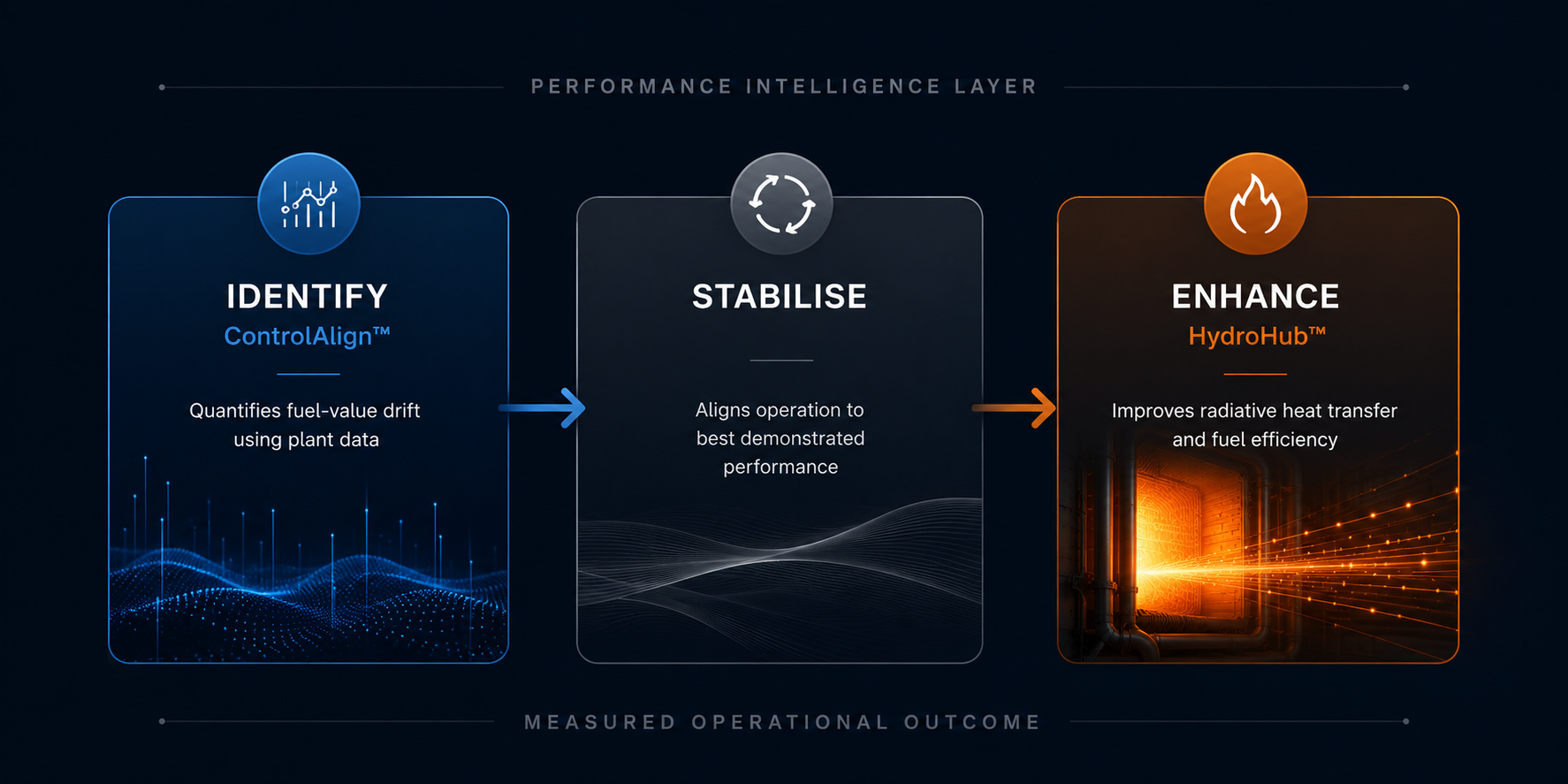
A structured approach to recovering and extending fuel-value performance.
What this changes inside the furnace.
How radiative behaviour shifts inside the combustion zone — without altering the boiler envelope.
HydroHub™ enhances the effectiveness of heat transfer within the furnace environment by improving radiative behaviour during combustion.
This results in:
- Greater heat absorption by working-fluid surfaces
- Reduced fuel required to maintain load
- More consistent thermal performance across operating conditions
This is not a change to the boiler. It is an improvement in how efficiently heat is transferred and utilised.
When HydroHub™ is applied.
Targeted to utility-scale thermal assets where a measurable performance gap has already been quantified.
HydroHub™ is typically introduced after performance analysis confirms a measurable gap between current operation and best demonstrated performance.
It is used where:
- fuel-value drift has been identified
- operational consistency has been evaluated
- further performance gains are achievable through improved heat transfer
This ensures deployment is targeted, justified, and economically grounded.
Radiative performance enhancement layer.
On-demand oxyhydrogen generation, rate-limited, interlocked with host plant parameters.
HydroHub™ introduces oxyhydrogen into the combustion environment to influence radiative heat transfer characteristics within the furnace.
This enhances the efficiency with which heat is transferred to boiler surfaces without altering core plant systems.
Generation rates are interlocked with host plant parameters including load, airflow, and fuel feed. No oxyhydrogen is stored. The system shuts down automatically outside predefined operating envelopes.
Performance outcomes are validated through plant Distributed Control Systems (DCS) and independent Measurement & Verification frameworks — producing auditable, institutionally credible results traceable to operational data.
Designed for integration within existing operations.
No pressure-part modification, no control-system dependency, no change to the operating envelope.
- No pressure-part modifications
- No dependency on control system changes
- Operates within existing plant envelope
- Compatible with standard O&M practices
Continuous high-temperature thermal processes.
Utility-scale boilers, process furnaces, and high-temperature kilns where heat-rate performance is economically material.
HydroHub™ is designed for large, continuous thermal processes where heat-rate performance, combustion stability, and emissions intensity are critical to operational and economic outcomes.
- Utility-scale coal-fired power plants (subcritical, supercritical, ultra-supercritical)
- Industrial boilers and process furnaces
- Cement and lime kilns
- Metallurgical and high-temperature process industries
HydroHub™ is not designed for mobile propulsion, residential use, or consumer-scale energy applications. Oxyhydrogen is intrinsically hazardous; HydroHub™ is rate-limited, interlocked, and subordinated to host plant controls within site safety and compliance frameworks.
The question that changed everything.
A single recurring question from industrial operators opened a deeper line of engineering inquiry.
For years industrial operators asked us a simple question:What is the calorific value equivalent of Brown's Gas?
At first glance the question appeared straightforward.
Yet after multiple industrial deployments across biomass boilers, thermal systems and industrial combustion environments, another question emerged:
Why did observed performance improvements often appear larger than could be explained by the direct energy contribution of the gas itself?
The search for that answer led beyond conventional fuel accounting and into the physics of combustion itself.
A widening line of inquiry.
As industrial deployments accumulated, YBG began investigating a series of interconnected combustion and heat-transfer phenomena.
The investigation extended across:
- 01Combustion kinetics
- 02Radical reaction pathways
- 03Flame emissivity
- 04Radiative heat transfer
- 05Combustion completeness
- 06Energy conversion effectiveness
The investigation suggested that Brown's Gas may influence not only combustion chemistry but also the effectiveness with which thermal energy is transferred into useful industrial output.
This represented a fundamentally different perspective from simple calorific value calculations.
From Brown's Gas to thermodynamic insight.
An engineering investigation that followed evidence wherever it led.
01
Industrial Oxyhydrogen
02
Industrial Deployment
03
Observed Performance Improvements
04
Questioning Conventional Explanations
05
Combustion Physics Investigation
06
Radiative Heat Transfer Analysis
07
Thermodynamic Performance Insights
08
ControlAlign™ Thermodynamic Visibility Architecture
A more complete explanation.
Conventional accounting often evaluates Brown's Gas solely through additional fuel energy. The evidence pointed further.
Traditional explanations often attempt to evaluate Brown's Gas solely through the lens of additional fuel energy.
YBG's industrial investigations suggested that a more complete explanation may involve:
- 01Improved combustion characteristics
- 02Enhanced flame behaviour
- 03Improved radiative heat transfer
- 04More effective energy coupling within thermal systems
- 05Improved conversion of fuel energy into useful process output
This perspective continues to inform YBG's ongoing research into industrial thermodynamics.
A broader industrial challenge revealed itself.
The mechanisms governing efficiency, heat rate, fuel intensity and emissions are rarely visible within conventional operational reporting.
The effort to understand Brown's Gas ultimately revealed a broader industrial challenge.
Many of the thermodynamic mechanisms governing efficiency, heat rate, fuel intensity and emissions are not directly visible within conventional operational reporting systems.
Routinely Measured
Outcomes
Fuel, steam, heat rate, emissions, production output.
Rarely Visible
Thermodynamic Causes
The combustion and heat-transfer mechanisms that produce those outcomes.
This realization contributed to the development of ControlAlign™, YBG's thermodynamic visibility architecture.
From observation of effect to visibility of cause.
Industrial measurement systems describe outcomes. The deeper challenge is the thermodynamics beneath them.
Industrial operators have traditionally measured:
- Fuel consumption
- Steam production
- Heat rate
- Emissions
- Production output
These measurements are essential.
Yet they primarily describe effects.
The deeper challenge is understanding the thermodynamic causes that produce those outcomes.
The engineering journey behind Brown's Gas helped illuminate the importance of making those causes visible.
How a HydroHub™ intervention is delivered.
A structured Evaluate → Engineer → Integrate → Verify workflow for utility-scale combustion enhancement.
HydroHub™ is delivered as a self-contained industrial thermal intervention. Each deployment follows the same engineering workflow, scaled to the asset's combustion architecture and operating envelope.
Evaluate
Combustion architecture, fuel chemistry and thermal envelope are reviewed against the asset's existing performance records to establish the engineered baseline.
Engineer
On-demand oxyhydrogen generation is sized, rate-limited and interlocked with host plant controls. Injection geometry is matched to the radiant section.
Integrate & Verify
Combustion-adjacent integration, commissioning under host interlocks, and verified fuel-intensity reduction under independent Measurement & Verification protocols.
The result is a measurable improvement in radiative heat transfer and fuel intensity, sustained across normal operating load.
Evaluate. Engineer. Integrate.
An auditable industrial workflow for combustion-adjacent oxyhydrogen integration at utility scale.
The HydroHub™ engineering framework:
Industrial Thermal Intervention Layer
Evaluate
Thermal Engineering Review
Combustion architecture, fuel chemistry and radiant-section behaviour established as the engineered baseline.
Engineer
Combustion Integration Design
On-demand oxyhydrogen sized and interlocked with host plant controls; injection geometry matched to the radiant section.
Integrate
HydroHub™ Deployment
Combustion-adjacent installation and verified improvement in radiative heat transfer and fuel intensity.
Verified Thermal Outcome
Performance improvements are evaluated in terms of:
Fuel reduction
Heat-rate improvement
Annual economic impact
using plant-specific operating data, under independent Measurement & Verification protocols.
Verified industrial outcomes.
HydroHub™ uplift is expressed in operator-native units and verified against the engineered performance baseline of the host asset.
Each deployment is evaluated against the asset's own engineered baseline — established from its existing performance records prior to commissioning.
Outcomes are reported as fuel reduction, heat-rate improvement and annual economic impact, audited under independent Measurement & Verification protocols.
A physical intervention, with measurable physical results.
YBG Group International
An independent industrial thermal-engineering platform.
HydroHub™ is the industrial oxyhydrogen platform of YBG Group International — engineered, manufactured and delivered as a standalone thermal intervention for utility-scale combustion assets. It is deployed under Advanced Technology Partnerships and consortium retrofit programmes targeting heat-rate uplift and industrial decarbonisation.
yullbrownsgas.com · HydroHub™ Industrial Oxyhydrogen
Engineered thermal intervention for utility-scale combustion.
Combustion-adjacent oxyhydrogen equipment extending the host asset's thermal performance through improved radiative heat transfer. Verified fuel reduction and lower emissions intensity under independent Measurement & Verification protocols.
Advanced Technology Partner
Deploy HydroHub™ through an Advanced Technology Partnership.
YBG is your Advanced Technology Partner and a private label manufacturer, supplying HydroHub™ Industrial Oxyhydrogen equipment for utility-scale retrofit programmes and consortium deployments at thermal power stations.
Contact the YBG team to discuss terms and technical compatibility for your target application.
Request ATP information →Advanced technology partners
We engage as an ATP partner embedding HydroHub™ Industrial Oxyhydrogen inside a broader thermal efficiency, heat-rate recovery and industrial decarbonisation service offering for utility-scale combustion assets.
ATP programmeEngage
Request the HydroHub™ technology brief
We'll send you the HydroHub™ technology brief covering system architecture, integration requirements, verified performance data, and private label arrangements.
- Commercially confidential. NDA available in mutual form or your standard format before document exchange.
- Advanced Technology Partner enquiries welcome at first contact.
- Engineering enquiries from utility operators, EPCs and consortium retrofit programmes welcomed.
FAQ
Frequently asked questions.
A short selection of the most common questions. The complete engineering knowledge base — fundamentals, applications, discovery narrative, safety and deployment — is maintained on the dedicated FAQ page.
Looking for engineering detail, safety principles or the ControlAlign™ discovery narrative?
Explore the complete knowledge base →Group structure
Three domains, one engineering group.
All three platforms are operated by YBG Group International Pty Ltd, an Australian company, ABN 22 636 934 999. The group's work with oxyhydrogen — Brown's Gas — dates back to 1985, and the equipment manufactured today is the direct engineering descendant of that work.
- yullbrownsgas.com — this site: private-label and OEM manufacture of industrial oxyhydrogen generation equipment for integrators, EPCs, resellers and consortiums who deploy under their own brand.
- ybgindustrial.com — HydroHub™: YBG's own branded engineered-deployment service, where YBG scopes, integrates, commissions and audits the intervention on the host plant.
- ybgglobal.com — YBG's Horticulture Hydrogen Channel: HERO Irrigation and Climate Systems for growers, sold directly, DDP worldwide.
Consumer Applications
Oxyhydrogen science extends into consumer wellness.
The same electrolysis and oxyhydrogen generation science explored by YBG in industrial settings also underpins a separate consumer wellness range. For personal hydrogen inhalation machines and domestic hydrogen water products, visit Hydrogen Machines— Australia’s source for consumer hydrogen inhalation machines.
Supply Channel
Private-Label & OEM manufacture of industrial oxyhydrogen generators.
yullbrownsgas.com is YBG's private-label and OEM supply channel for industrial oxyhydrogen generation equipment. Integrators, EPCs, and equipment resellers can deploy the technology under their own brand or as an unbranded OEM module, with YBG remaining the manufacturer and the buyer owning the deployment.
This is distinct from HydroHub™ at ybgindustrial.com, where YBG scopes, integrates, commissions, and audits the intervention on the host plant.
View equipment specs and terms →